 Pristupačnost
Access to clean water is among the most urgent global priorities, underpinning economic growth, societal well-being, and the integrity of natural ecosystems. Water stress is projected to intensify significantly in the coming decades: water demand is expected to increase by 55% by 2050, while the number of people in Europe living under water stress could nearly double by the 2070s. A critical, yet often underestimated, aspect of this challenge is the deterioration of water quality caused by contaminants of emerging concern (CECs) – a diverse group of substances including pharmaceuticals, per- and polyfluoroalkyl substances (PFAS), pesticides, flame retardants, personal care products, and other persistent micropollutants.
Conventional water and wastewater treatment plants (WWTPs), which typically rely on primary (mechanical) and secondary (biological) treatment, are fundamentally ill-equipped to cope with CECs. Studies consistently identify WWTPs as hotspots for the spread of CECs into receiving water bodies. While tertiary treatment can address some issues, effective and sustainable solutions targeting CECs removal are still not widely implemented. Consequently, the presence of CECs in WWTP effluents remains a major bottleneck in the safe conversion of wastewater into drinking water feedstocks, emphasizing the urgent need for advanced, energy-efficient treatment technologies.
Among CECs, pharmaceuticals and PFAS represent two particularly pressing categories. Pharmaceuticals are detected in water sources worldwide at concentrations ranging from pg/L to even mg/L, and several are included on the EU Water Framework Directive (WFD) Watch List due to their environmental relevance. PFAS, a group of more than 10,000 synthetic fluorinated chemicals used in numerous industrial and consumer products, are characterized by exceptional chemical and thermal stability, leading to widespread environmental accumulation and persistence in surface, ground, marine, and drinking waters. Both humans and ecosystems are threatened by PFAS exposure, and the EU has introduced strict regulatory measures, including PFAS limits in the Drinking Water Directive.
Advanced oxidation/reduction processes (AO/RPs), particularly solar photocatalysis, represent a promising solution for tertiary water treatment targeting CECs. Solar photocatalysis generates reactive oxygen species (ROS), primarily hydroxyl radicals (HO•) and superoxide radicals (O2•−), directly from solar energy, enabling pollutant degradation with low energy demand and no secondary waste generation. HO• efficiently degrades most pharmaceuticals, while O2•− and photogenerated electrons are essential for the reductive degradation of PFAS, which are resistant to oxidative attack due to highly stable C–F bonds.
However, many photocatalytic systems remain limited by their dependence on UV irradiation, highlighting the need for materials capable of efficient solar energy utilization.
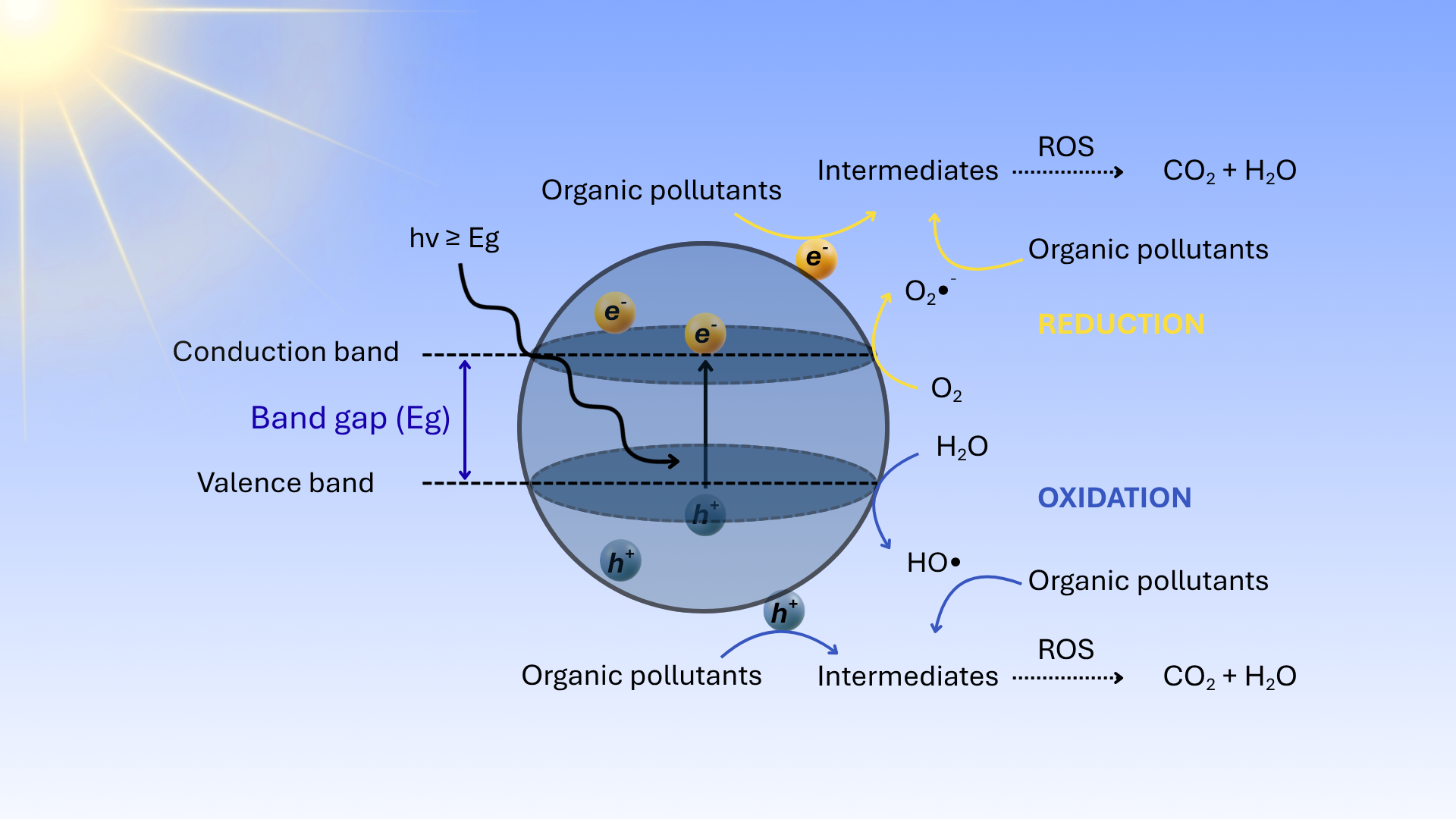
SOL-MAT-CLEAN develops advanced solar-active photocatalytic materials for the removal of CECs from water, with a particular focus on pharmaceuticals and PFAS. The project aims to address the limitations of conventional wastewater treatment technologies, which are often ineffective against persistent micropollutants and contribute to their continuous release into aquatic environments.
The project combines experimental and computational approaches to design and optimize solar-active photocatalysts capable of efficiently utilizing solar energy. Advanced material characterization techniques are employed to investigate the structural, morphological, optical, electrochemical, and surface properties of developed materials, while density functional theory (DFT) calculations are used to model electronic structure, charge-transfer processes, adsorption behavior, and degradation pathways at the molecular level. This integrated approach enables rational tailoring of photocatalyst properties towards improved activity and stability.
The developed materials are evaluated for degradation of selected pharmaceuticals and PFAS in both suspension and immobilized form, using laboratory-scale batch reactors and pilot-scale flow-through systems with immobilized photocatalytic films. Particular attention is given to degradation mechanisms, transformation products, mineralization efficiency, changes in biodegradability, and ecotoxicological effects under realistic water treatment conditions.
By integrating solar-driven photocatalysis, advanced material engineering, and computational modeling, SOL-MAT-CLEAN contributes to the development of sustainable, energy-efficient, and environmentally friendly technologies for advanced water treatment and protection of water resources.