 Pristupačnost
In today’s fast-paced and increasingly health-challenged society, chronic diseases, stress, and complex health conditions require innovative and more effective therapeutic solutions. Conventional pharmaceuticals often fail due to variable patient responses, side effects, and the lack of personalisation in drug development. Consequently, designing novel bioactive molecules with enhanced efficacy, selectivity, and adaptability has become a central challenge in modern pharmaceutical and biotechnological research.
Natural products are a valuable source of biologically active compounds with well-documented therapeutic potential. However, their direct application is often limited by poor bioavailability, rapid metabolism, and insufficient stability. Recently, greater attention has been given to dimeric forms of natural products, which frequently exhibit significantly altered – and often enhanced – biological activity compared to their monomeric counterparts. This improvement is largely due to their ability to interact with multiple receptor sites simultaneously, resulting in stronger and more selective biological responses.
Dimers, including both homodimers and heterodimers, can be derived from a wide range of natural compounds such as flavonoids, phenols, alkaloids, terpenoids, and polyketides. This structural diversity offers vast possibilities for generating novel molecules with tailored physicochemical and biological properties. Moreover, combining dimerisation with additional modification strategies – such as hydroxylation, methylation, or glycosylation – provides an expanded platform for designing advanced bioactive compounds.
Despite their potential, synthesising natural product dimers remains challenging. Conventional chemical approaches are often associated with low selectivity, high energy consumption, formation of undesired by-products, and the use of environmentally harmful reagents. In contrast, enzyme-catalysed processes offer a more sustainable and selective alternative. Enzymes such as polyphenol oxidases and cytochrome P450 monooxygenases enable controlled oxidative coupling reactions, facilitating the formation of dimers and structurally diverse derivatives under mild conditions.
To further improve process efficiency and sustainability, this project integrates advanced reaction engineering approaches, particularly the use of milli- and microreactor systems. These flow-based platforms provide superior heat and mass transfer, short diffusion paths, and precise control over reaction conditions, resulting in higher conversions, improved selectivity, and reduced reaction times compared to conventional batch systems. Additionally, microreactors enable process intensification and integration, allowing the incorporation of micromixers, separation units, and analytical tools within a single system.
The main objective of this project is to develop and optimise both chemical and enzymatic strategies for the dimerisation and functional modification of selected natural compounds – including apigenin, resveratrol, ferulic acid, and coumarin – to generate novel or enhanced bioactive molecules. The research will involve systematic comparison of batch and flow processes, as well as macro-, milli-, and microscale systems, combined with process modelling, optimisation, and reactor design.
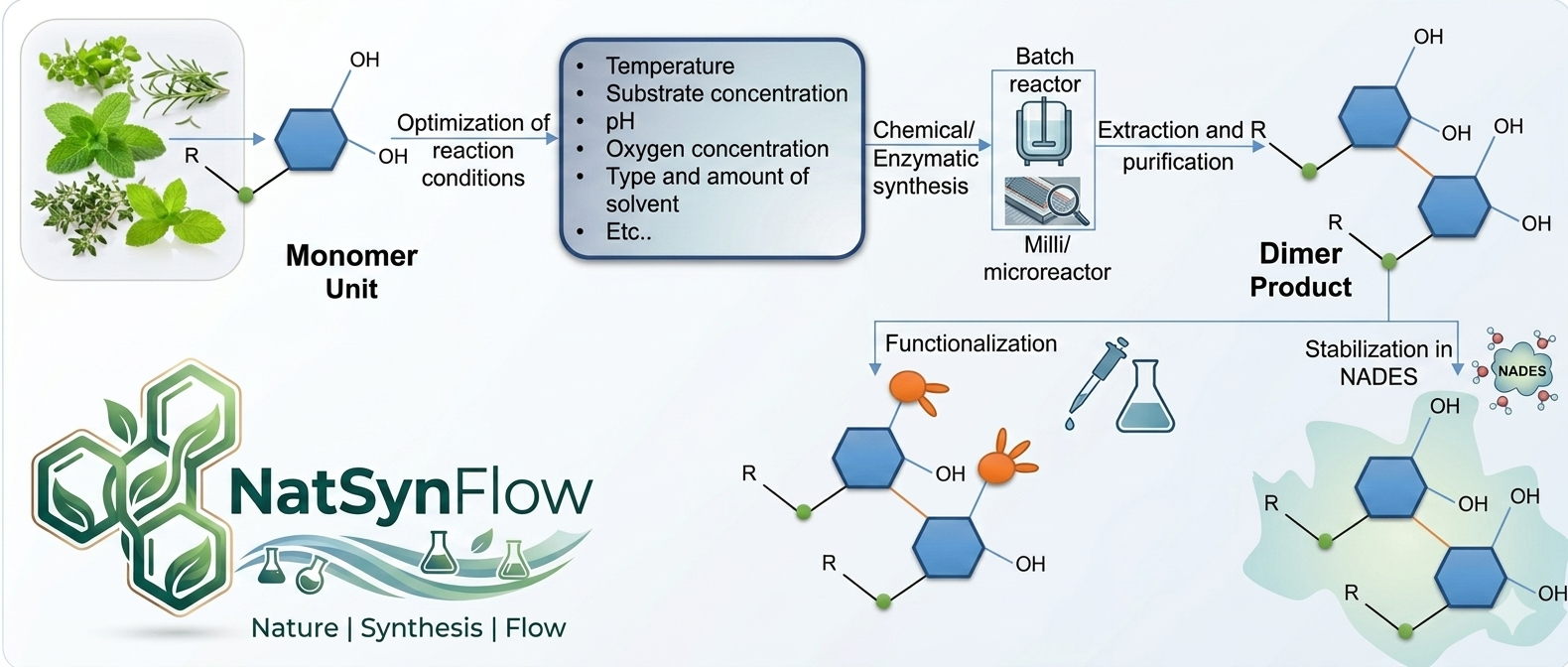
An interdisciplinary approach will be used, integrating principles from organic chemistry, chemical engineering, biotechnology, and biocatalysis. Special emphasis will be placed on the use of immobilised enzymes and whole-cell systems to improve catalyst stability, reusability, and overall process sustainability. Continuous flow operation will be explored to ensure stable reaction conditions, minimise by-product formation, and enhance productivity.
Ultimately, this project aims to establish a versatile and sustainable platform for producing natural product dimers with improved pharmacological properties. By combining biocatalysis with microreaction technology and process modelling, the proposed research will contribute to the development of next-generation bioactive compounds with potential applications in the pharmaceutical, food, and cosmetic industries, supporting the advancement of personalised and environmentally responsible therapies.