 Pristupačnost
Bone defects caused by trauma, disease or aging represent a significant medical challenge, increasing the need for biomaterials that support bone regeneration while minimizing complications such as infection or poor integration. Mesoporous bioactive glasses and glass-ceramics are attractive biomaterials due to their osteoconductive properties, high porosity, biocompatibility and antimicrobial activity.
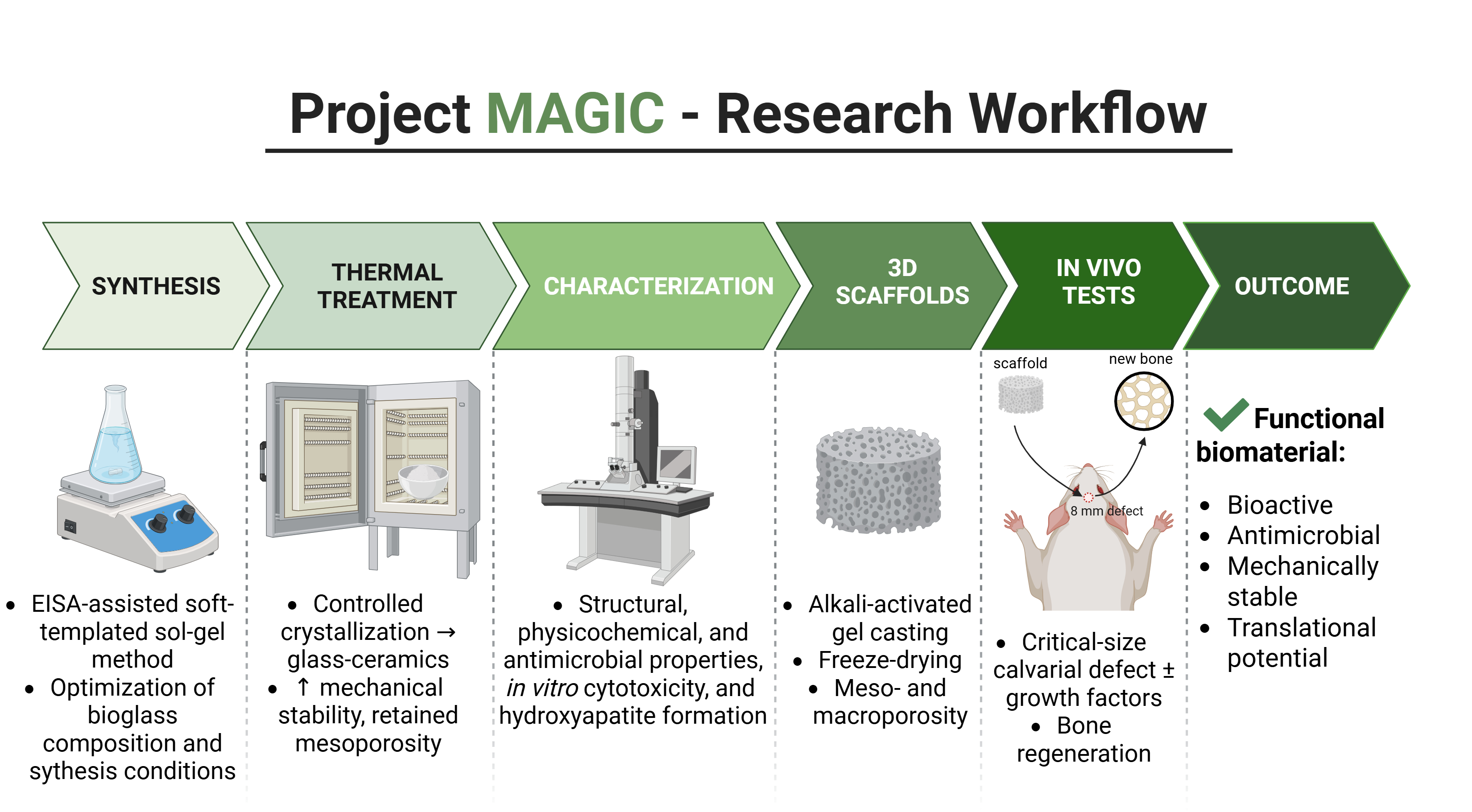
The aim of this project is to synthesize mesoporous bioactive glasses using an evaporation-induced self-assembly (EISA)-assisted soft-templated sol-gel method, with optimization of synthesis parameters and composition, starting from established formulations and incorporating functional elements such as cerium, copper, and silver to introduce antimicrobial activity. Subsequently, controlled crystallization will be carried out to obtain glass-ceramics, with particular attention to retaining mesoporosity while improving mechanical stability. The resulting materials will be characterized to determine their structural, physicochemical and antimicrobial properties, in vitro cytotoxicity, and ability to form a hydroxyapatite layer.
The most promising samples will be used to prepare porous three-dimensional scaffolds by alkali-activated gel casting and freeze-drying. The scaffolds will be characterized with emphasis on mechanical properties and macro- and micro-scale porosity. Finally, the most promising samples will be tested in vivo using a critical-sized calvarial defect model in rats, with and without growth factors, to evaluate their potential for bone regeneration and clinical application.
The project is expected to deliver optimized material compositions and porous scaffolds with improved bioactivity, antimicrobial properties and mechanical stability, validated through in vitro and in vivo studies.
The novelty of this project lies in linking material design, synthesis optimization and biological evaluation within a single workflow, from synthesis to in vivo testing. Such a direct connection between materials science and clinical research remains relatively uncommon.
Through close collaboration with medical researchers, the project aims to develop functional and safe biomaterials with real potential for clinical application, going beyond laboratory-scale studies.