HrvatskihrEnglishen
Printed carbon electrodes (PCEs) are the dominant transducer platform for low-cost electrochemical biosensors, providing a rich surface chemistry, but their as-fabricated surfaces suffer from insulating binders and a limited density of electroactive sites. A wide range of post-processing strategies exists to overcome this, yet their effects have been studied in a fragmented, platform-specific manner, and no systematic cross-platform framework links activation parameters to analytical performance. CARBOSENS addresses this gap by developing high-performance biosensor platforms based on diverse PCEs, including screen printed, inkjet-printed, direct ink written and fused-deposition-modelled 3D-printed electrodes, whose surfaces are tuned through controlled graphene-oxide (GO) formation, primarily via electrochemical exfoliation, complemented by intense pulsed light and plasma treatments.
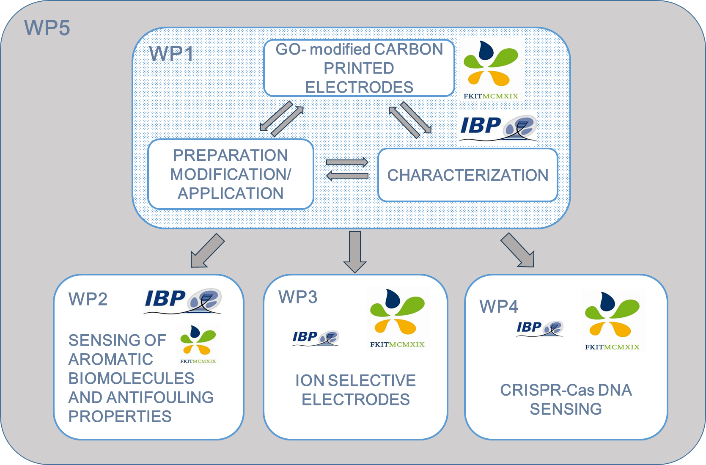
The overall objective of this project is to develop high-performance, selective biosensor platforms based on diverse printed carbon electrodes (PCEs) modified with variously prepared GO structures (Scheme 1). These biosensors will be designed specifically for the detection of various biomedically important molecules. The specific objectives, obtained through 4 scientific work packages, include:
(i) scalable fabrication of PCEs and optimization of their surface activation/oxidation protocols
(ii) demonstration of improved direct voltammetric determination of small aromatic species (drugs, metabolites) in complex biological matrices
(iii) development of novel ion-selective electrodes based on 3D-printed electrodes
(iv) covalent immobilization of ssDNA for medically relevant CRISPR-Cas sensing for genomic diagnostics